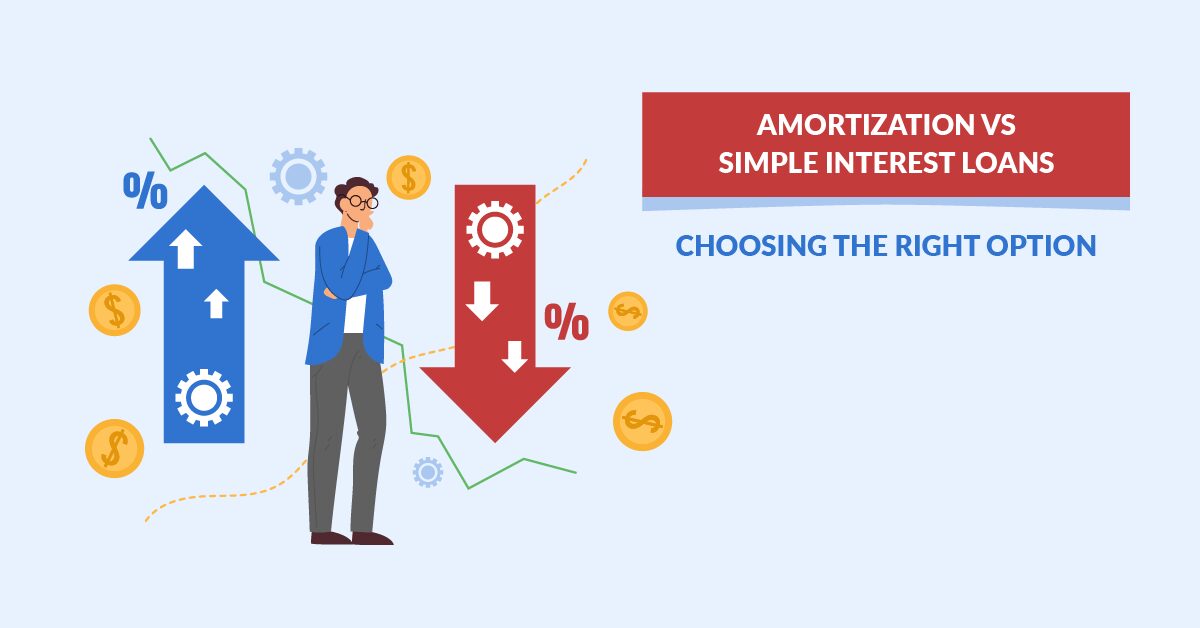
The primary distinction between amortizing loans and simple interest loans lies in the allocation of payments toward interest. In an amortizing loan, the portion of each payment allocated to interest decreases over time, while the portion allocated to the principal increases. Conversely, in a simple interest loan, the amount of interest paid per payment remains constant over the loan term.
Amortizing loans are commonly associated with long-term financing, as they allow for gradual repayment of both principal and interest. On the other hand, short-term loans typically utilize a simple interest rate structure, where the interest payments per payment remain consistent throughout the loan duration.
Understanding this fundamental difference can help borrowers assess the long-term cost and payment structure of different loan options based on their specific needs and financial circumstances.
Choosing the right financing option for your business can be really difficult. There are hundreds of different lenders who will all offer you different types of financing. Which one is the best for your business? One of the most important factors to consider when choosing between financing options is the payback amount. Generally, loans fall into two categories of payback: Amortizing Loans and Simple Interest Loans. Below, we will discuss the differences between simple interest & amortized interest to help you decide which option is best for your business.
What Are Amortization Loans?
Amortized loans are loans that you can pay off over time. Merchants pay back the principal loan and the interest. The principal loan is the initial amount of money borrowed while the interest is the cost of borrowing the money. Payments are generally required on a daily, weekly, or monthly basis. To find out the cost of capital multiply the principal value of the loan by the interest rate. Then, divide the result by the number of paybacks in each year.
Amortization Example :
if you take out $90,000 paid back monthly over a year at a 10% interest rate, you would find out that your monthly payback would be $8,250. During your first month’s payment, $7,500 would go towards your principal loan payback, and $750 would go towards interest. With a traditional amortizing loan, the payment amounts remain constant over the life of the balance. However, the amount of money that goes towards paying off interest decreases while the amount of money going toward the principal payback increases. The second monthly payment amount in our previous example is still $8,250, but because you have already made the first payment of $7,500 towards paying back the principal, the remaining balance on your loan is only $82,500.
Therefore, this means that less principal is left to multiply by the interest. When you recalculate your payment of $8,250, only $687.50 will go towards interest while $7,562.50 will go towards the principal payback. As the life of the loan goes on, you would see that in each payment, less money goes towards interest while more money goes towards principal payback. Nonetheless, the total value of each payment remains the same.
What Is Simple Interest?
Simple interest loans are structurally different than amortizing loans. The amount of money going towards interest and principal payback remains the same for each payment. Simple interest loans are generally shorter in term length and are issued with a higher interest rate than amortizing loans. Since interest and principal payback amounts remain constant for each payment, you only need to know the interest rate, term length, payment frequency, and total number of payments to figure out what portion of the payments will go toward each.
Simple Interest Example
if you get an 8-month loan for $50,000 at a factor rate of 1.3 with weekly payments. Then, you will have to pay back a total of $65,000 over 8 months. 8 months equates to 40 weeks, therefore you would have 40 total payments. To calculate the weekly payment amount you would need to divide $65,000 by 40 which comes out to payments of $1,625 each week. Of the $1,625, $1,137.50 would go towards your principal payback and $487.50 would go towards interest.
Simple Interest vs Amortized Interest: Key Differences
Let’s examine the key differences between simple interest and amortized interest. These examples highlight the contrasting features of the two loan types.
Firstly, with an amortizing loan, each subsequent payment consists of a higher proportion towards the principal and a lower proportion towards interest. In contrast, a simple interest loan requires equal payments towards both principal and interest with each payment.
Furthermore, amortizing loans typically involves compounding interest, meaning the interest accrues on both the principal amount and any accumulated interest. On the other hand, simple interest loans only calculate interest based on the initial principal amount.
To summarize, the main distinctions between simple interest and amortized interest lie in the changing proportions of principal and interest payments over time, and the presence of compounding interest in amortizing loans compared to the straightforward calculation of simple interest in simple interest loans.
When it comes to compounding interest, it involves calculating interest on both the original loan amount (principal) and any accumulated interest. The frequency at which compounding occurs, such as daily, weekly, or monthly, often aligns with the payment frequency. As a result, the more payments made, the more compound interest will accrue over time.
Additionally, amortizing loans are typically long-term loans, while simple interest loans are often short-term financing solutions. Due to their longer duration, amortizing loans generally have a higher cost of capital. Although individual payments may be lower, the total number of payments leads to a higher overall cost in the long run.
On the other hand, simple interest loans have a lower cost of capital. While the total amount paid is less, each individual payment tends to be higher, which could potentially strain your cash flow in the short term.
It’s important to consider the implications of compounding interest and the cost of capital when choosing between amortizing loans and simple interest loans. Evaluating your specific financial situation and cash flow capacity will help determine the most suitable financing option for your needs.
It is crucial to consider the impact on your cost of capital if you choose to repay your loan early. In some cases, amortizing loans allows for early repayment, eliminating any additional interest that would have been incurred. However, with a simple interest loan, you may be subject to a prepayment penalty, as the lender relies on the interest payments from each scheduled payment.
Before signing any loan agreement, it is important to discuss the terms with your lender. Ensure that you have a clear understanding of the loan’s provisions regarding early repayment and any potential penalties associated with it.
Furthermore, requesting an APR (Annual Percentage Rate) from your lender is recommended. Unlike the interest rate, which only reflects the cost of borrowing money, the APR provides a more comprehensive view of the total expense associated with taking out a loan. It incorporates the interest rate as well as any fees associated with borrowing, such as origination fees, application fees, closing fees, and others. Additionally, the APR considers the loan’s repayment term. Essentially, the APR represents the overall cost of borrowing expressed as an interest rate.
Considering both the interest rate and the APR allows for a more informed evaluation of the total price of borrowing money and assists in making better decisions regarding loan options.
Simple Interest vs. Amortized Loan: Which Type of Loan is Best for Your Business?
While there is no right answer, both types of loans work differently. Amortizing loans entails longer terms and lower payments, but the total cost of capital is generally higher. On the other hand, simple interest loans have a lower cost of capital but generally mean shorter terms and higher APR on each payment. In addition, if you pay off a simple interest loan early, you are more likely to incur a prepayment penalty because the same amount of money goes towards interest on each payment.
REIL Capital can help you find the best financing options for your business. We offer custom-tailored financing and working capital packages with your business priorities in mind. If you want to find out more about our business financing options fill out our commitment-free application to help us better understand how your business operates and allow one of our business financing representatives to come up with a business financing solution that best fits your business needs.